
Tien Wong, Founder and Executive Chairman, CONNECTpreneur | February 2, 2026
Many founders believe the capital markets have frozen. They haven’t. The underwriting standards changed — quietly, structurally, and for good.
Across dozens of investor conversations over the past year, one pattern is clear: capital is still being deployed, but decision-making now looks more like sponsor-style underwriting than venture-style speculation.
In the ZIRP era, narrative and market size often carried weight that proof hadn’t yet earned. Today, investors prioritize downside protection, tangible evidence, and operational discipline far earlier in a company’s lifecycle.
This shift has created what I call the New Underwriting Stack — a layered set of signals investors now require before committing their time, reputation, and capital. Most stalled fundraising rounds aren’t failing because the core idea is weak. They’re failing because one or more layers of this stack are missing.
Below is how the stack works — and how to align your company with the new standards of investor confidence.
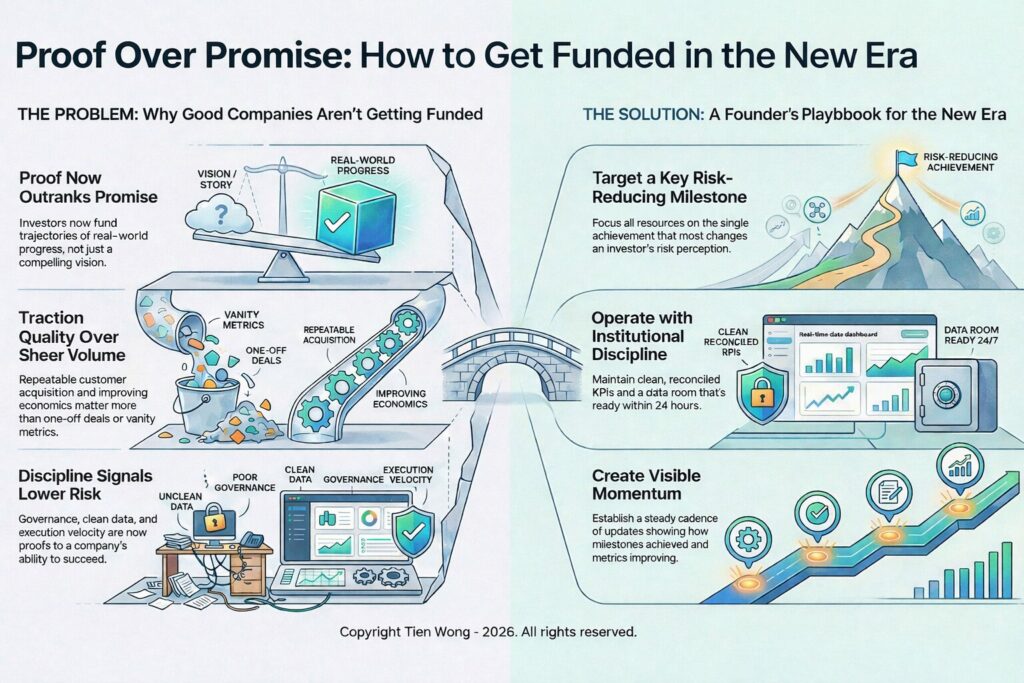
Mastering these six pillars is no longer optional. Together, they signal that your company is built on discipline, not hope.
1. Proof Now Outranks Promise
Investors fund trajectories of proof, not static stories. A roadmap isn’t enough — they want evidence the hardest assumptions on that roadmap are already being tested and retired.
Great founders don’t just describe where they’re going. They show that risk is already coming off the table.
2. Traction Is Underwritten for Quality, Not Volume
Traction is no longer about vanity metrics. It’s evidence of process maturity.
Investors are asking:
Strong traction today looks less like explosive top-line growth and more like improving efficiency curves.
3. Governance Maturity Shows Up Earlier
Investors now underwrite decision discipline long before a formal board exists.
One quiet test: When founders are asked, “What are you not doing right now?” — is the answer clear?
Founders who can articulate both their focus and their deliberate trade-offs demonstrate an understanding of capital allocation, not just ambition.
4. Diligence Hygiene Is a Risk Signal
Your data room is no longer administrative — it’s diagnostic.
When numbers don’t reconcile across the deck, model, and diligence files, investors don’t just question the math. They question management control.
Clean, reconciled KPIs and financials signal operational discipline. Scattered or shifting information signals hidden risk.
5. Execution Velocity Is a Credibility Metric
Investors now underwrite how a company moves, not just what it plans.
Velocity means milestones are being hit, gaps are being filled, and metrics are steadily improving. Consistent forward motion signals competence under pressure. Stalled or erratic progress creates doubt.
6. Investor Ownership Is Part of the Risk Equation
Capital is no longer assumed to be passive. The best investors today engage like owners — helping with governance, hiring, and prioritization.
The most founder-friendly investors in this market are often the most disciplined ones. They reduce the odds of catastrophic mistakes and add hard-earned pattern recognition.
Understanding the stack is step one. Operationalizing it is what gets you funded.
1. Identify and Execute a Key Risk-Reduction Milestone
Define the single milestone that fundamentally changes investor risk perception and justifies your next valuation step-up. Focus the majority of your resources there.
If your next valuation depends more on market sentiment than a concrete milestone, investors will feel that immediately.
2. Elevate Operating Discipline to Institutional Standards
Operate as if you are already institutionally backed. Keep reconciled KPIs, current financials, and a clean, shareable data room.
If your internal numbers don’t match your external story, you don’t have a storytelling problem — you have an operating problem.
3. Create and Communicate Visible Momentum
Establish a steady cadence of updates for current and prospective investors. Show milestones achieved, metrics improving, and risks being reduced.
A clear monthly update with real progress often builds more credibility than another polished pitch deck.
4. Attract Owner-Like Capital
Target investors who engage deeply, ask hard questions, and support companies beyond writing a check.
Avoid capital that is passive, overly promotional, or uncomfortable with governance conversations. That kind of money often creates more risk than it removes.
Use these questions to identify gaps before investors do.
Milestones
Traction Quality
Operating Discipline
Execution Momentum
Investor Fit
If several of these questions are hard to answer, your underwriting stack may not yet be fully built.
Fundraising hasn’t disappeared. Speculative underwriting has.
The companies raising capital today aren’t just better storytellers. They are visibly de-risking their businesses, operating with institutional discipline, and aligning with investors who think like owners.
Founders who internalize this shift won’t just survive this cycle. They’ll build companies that are structurally stronger, more resilient, and far more valuable in the next one.
If this perspective was useful, I share ongoing investor-side insights for founders and executive teams several times a month on LinkedIn. You can follow along here: https://linkedin.com/in/tienwong

© Big Idea CONNECTpreneur. All rights reserved. 2024