
Tien Wong, Founder and Executive Chairman, CONNECTpreneur | April 2, 2026
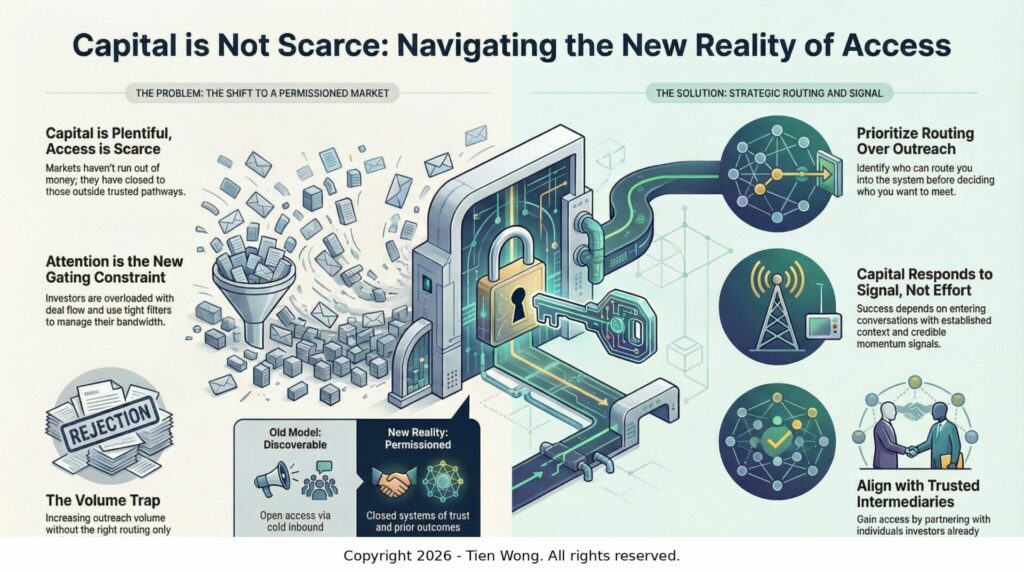
A lot of founders think we’re in a capital-constrained market.
We’re not.
Capital is there. Funds are raised. Family offices and UHNWIs are active. Strategic investors are deploying. Rounds are getting done every week.
But not for most companies.
That’s not a contradiction.
It’s a structural shift.
What changed isn’t the supply of capital.
It’s how capital is accessed.
We’ve moved from something that felt like an open market to something much closer to a permissioned system.
It used to feel discoverable:
That model is largely gone.
Today, capital flows through:
If you’re outside those pathways, you’re effectively invisible—no matter how strong your company is.
Investors aren’t looking for more deal flow.
They’re overloaded with it.
What they’re actually managing now is attention:
Attention has become the gating constraint on capital.
Attention is the new currency and it is tightly controlled.
Inside most firms, a deal doesn’t gain real traction unless there’s a clear answer to this question:
Why is this in front of us—and why now?
If that context isn’t already established, the deal rarely progresses.
Cold inbound isn’t evaluated the way founders think it is.
It’s filtered.
Across multiple active raises, the pattern is consistent.
Two companies can look nearly identical on paper:
One closes quickly.
The other struggles for months.
The difference usually isn’t the business.
It’s how they were routed into the system.
In this market, being right isn’t enough.
You have to be routed correctly.
As markets tightened, investors didn’t just become more selective about what they invest in.
They became more selective about where they spend attention.
Time, reputation, and internal bandwidth became binding constraints.
So instead of expanding their funnel, most investors did the opposite:
From the outside, it looks like inactivity.
From the inside, it’s disciplined filtering.
Most founders respond by increasing activity:
But volume doesn’t solve an access problem.
It amplifies it.
If you’re outside the right pathways, scaling outreach just scales rejection.
This isn’t about doing more.
It’s about changing how you enter the system.
Capital doesn’t respond to effort.
It responds to signal.
Capital hasn’t disappeared.
It has consolidated into systems of trust.
Those systems are built on:
Breaking into them requires more than a strong pitch.
It requires positioning, context, and access.
Capital is not scarce.
Access is.
The founders who break through don’t chase capital.
They find a way into the rooms where it’s already moving.

© Big Idea CONNECTpreneur. All rights reserved. 2024